Meaning Lens

Most worries never reach a therapist. We build psychology tools for the rest.

Meaning Lens is a small team of psychology researchers and developers in Cheongju, South Korea. We take questionnaires and theories from published research and turn them into short tests and readings people can use on their phones.

Both apps are live in Korean.

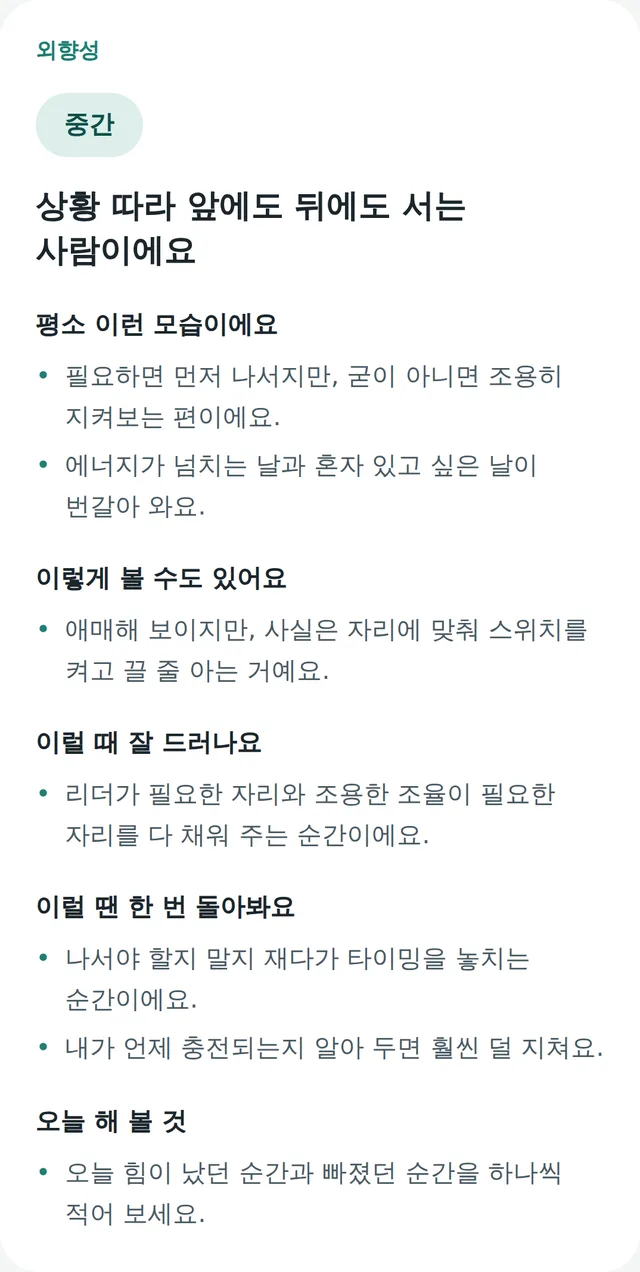
Meaning Test screen: a reading for extraversion, written in Korean
Meaning TestA reading for extraversion
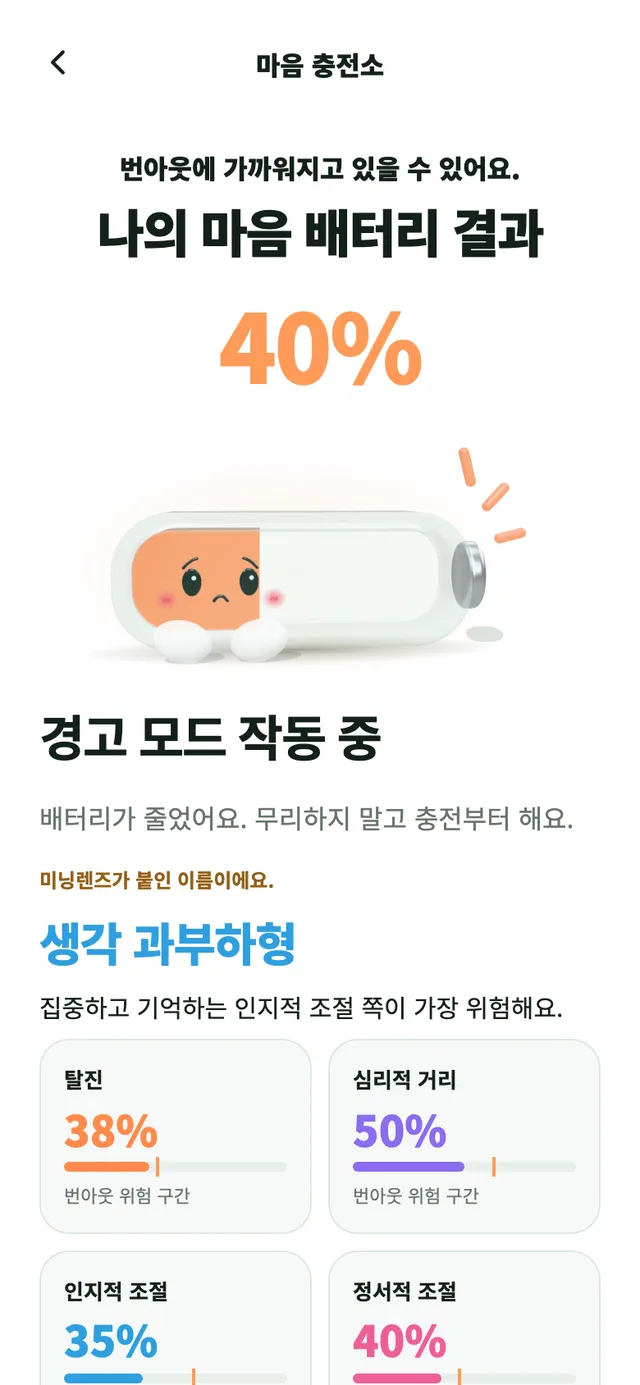
Burnout test result screen showing a battery at 40 percent
Burnout testBattery at 40%

Why we started

In Korea, many people turn to saju, fortune-telling by birth date, and to online personality quizzes to make sense of themselves. Counseling is expensive, and most people feel their problem isn't serious enough for it. So everyday stress about work, school and relationships goes unexamined until it gets worse.

Psychology already has good tools for this: validated scales and decades of research on stress, relationships and personality. Most of them stay in journals. We want them on people's phones, in plain language.

  1. We started Meaning Lens with a diary app that read entries in four steps, from the events of a day to the story of a life. Very few people wrote every day, and the analysis needed weeks of entries before it said anything useful.

  2. Passed the first round of Everyone's Startup (모두의 창업), a national startup program run by Korea's Ministry of SMEs and Startups.

  3. We changed the problem, not just the features. Start with a short test anyone can finish in a few minutes, explain the result with research, and grow toward deeper analysis and conversation.

  4. Released the burnout test and Meaning Test as public betas.

  5. Building the first prototype of Meaning World.
Meaning Test 미닝 테스트 · live beta

Short tests built on scales from published research, such as the PHQ-9, the Big Five Inventory and the Burnout Assessment Tool. Score ranges come from the original papers, and each reading shows its source.

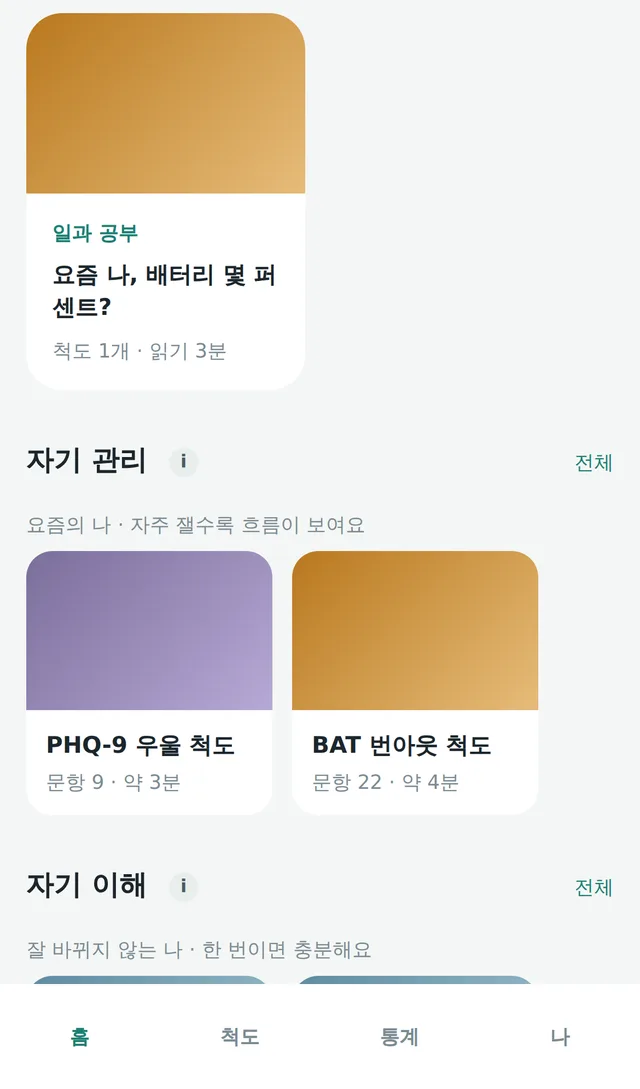
Tests are grouped by what they're for: some you take once to understand yourself, others you repeat to see how you're doing over time.

Open Meaning Test
Meaning Test home with tests grouped into self-care and self-understanding
HomeTests grouped by purpose
A plain-language reading for an extraversion score
ReadingWhat the score looks like day to day
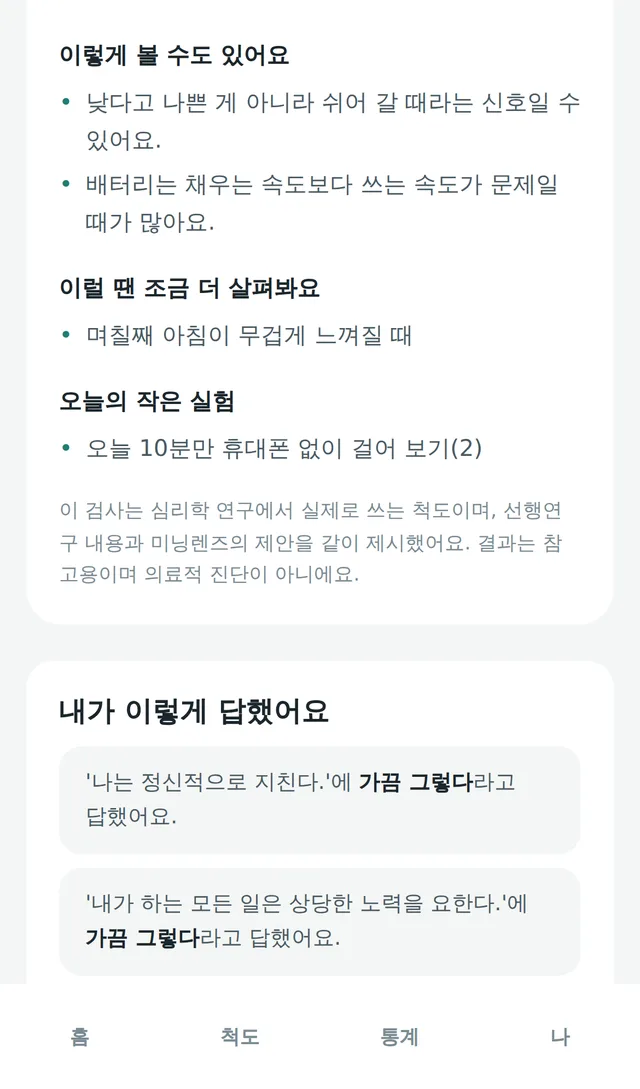
Result page quoting the person's own answers and a note that results are not a diagnosis
Your answersQuoted back, with a not-a-diagnosis note

Burnout test 마음 충전소 · live beta

Twenty-two questions from the Burnout Assessment Tool (BAT). The result shows up as a phone battery: how much charge is left, and which of four areas is draining it.

Share the link and friends can leave a short note of support. Each note adds a little charge back.

Take the burnout test
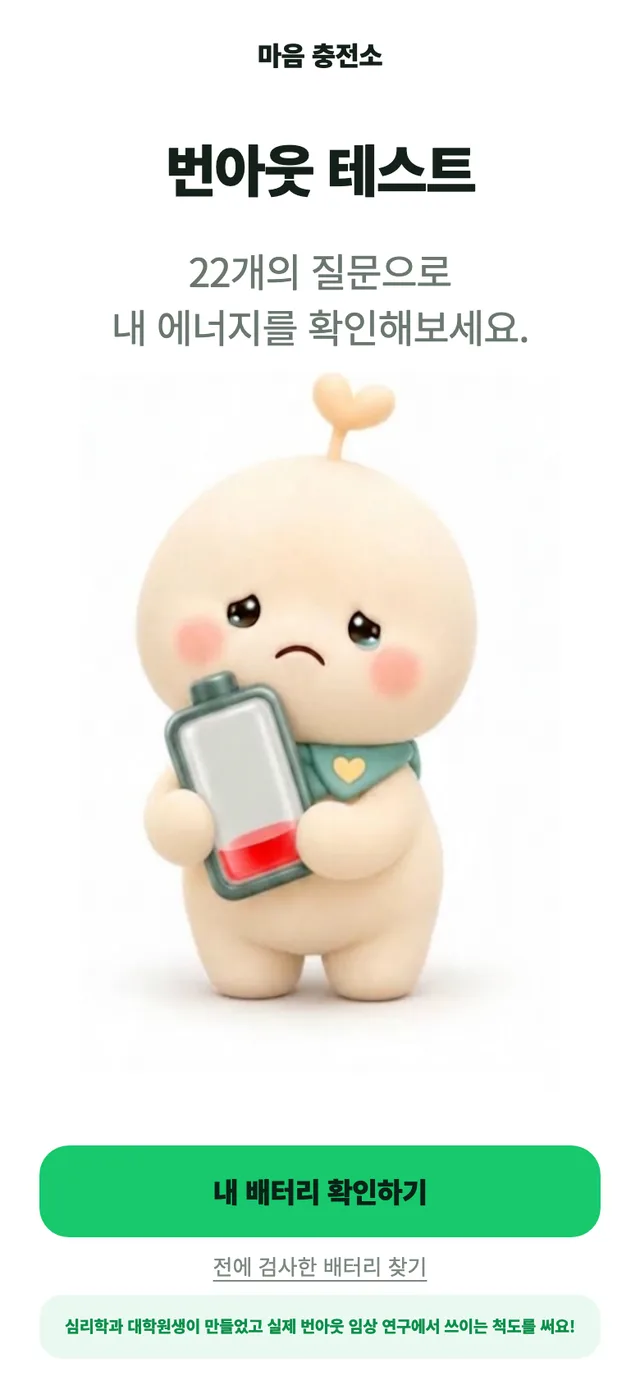
Burnout test start screen with a tired battery character
Start22 questions
Result: battery at 40 percent with four areas below
ResultOverall charge and four areas
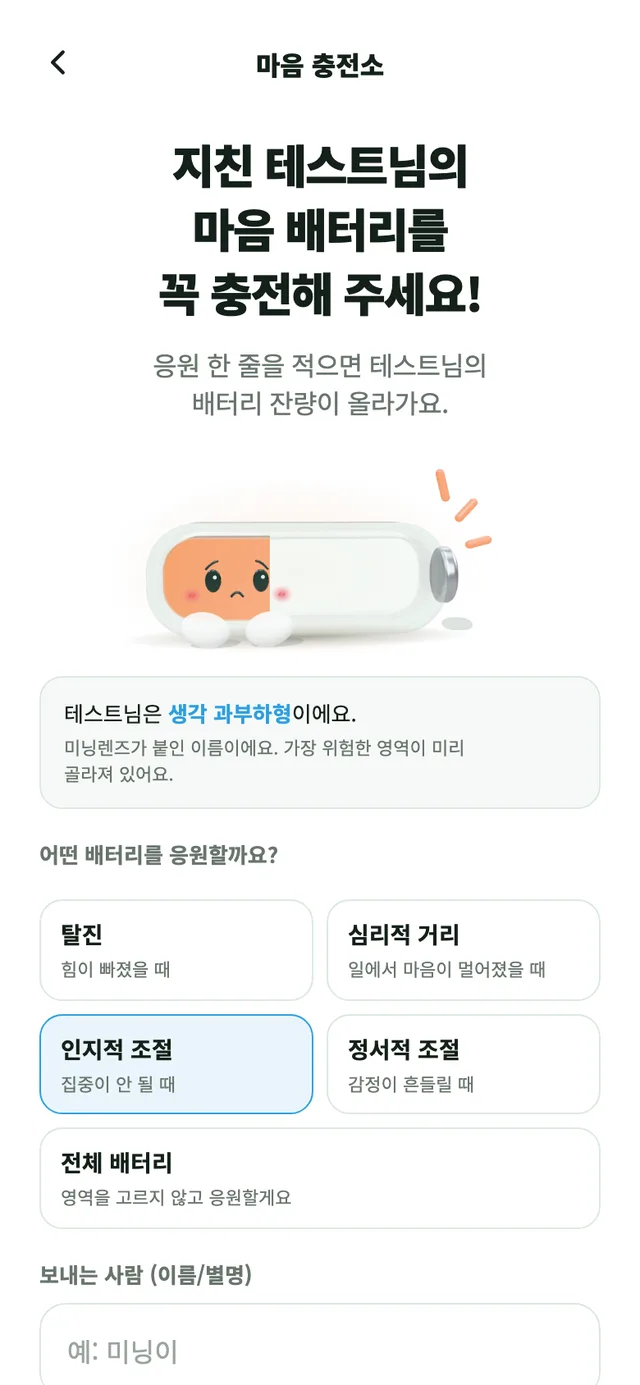
Page a friend sees, with a box for a note of support
Friend's viewA note of support adds charge

Meaning World 미닝월드 · in development

Practice a conversation with someone in your life. Upload a KakaoTalk chat or describe the person, and Meaning World builds a character that talks like them.

Then it explains what is going on, using social psychology: how that person tends to act, how you act around them, and what happens between the two of you.

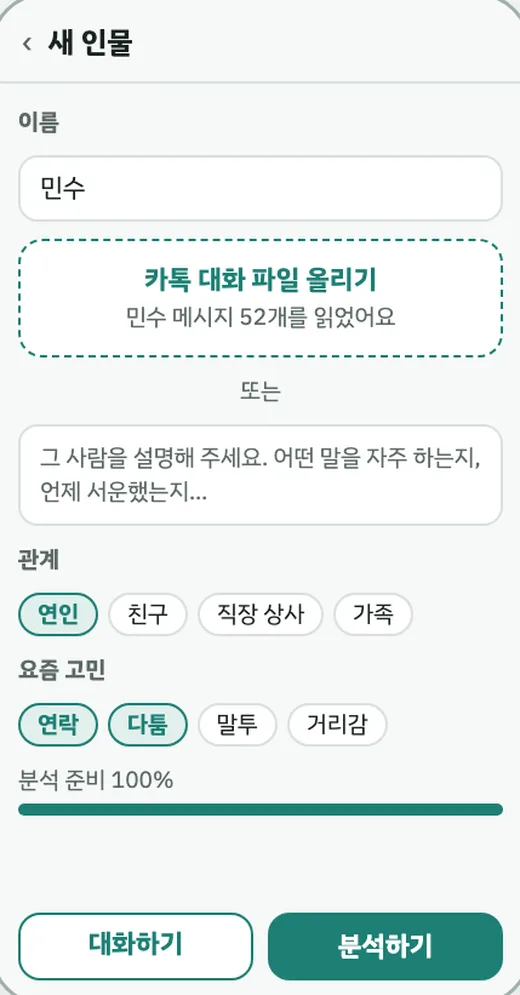
Prototype: creating a character from a KakaoTalk export
CreateFrom a chat export or a description
Prototype: chatting with the character
TalkSay what you couldn't say
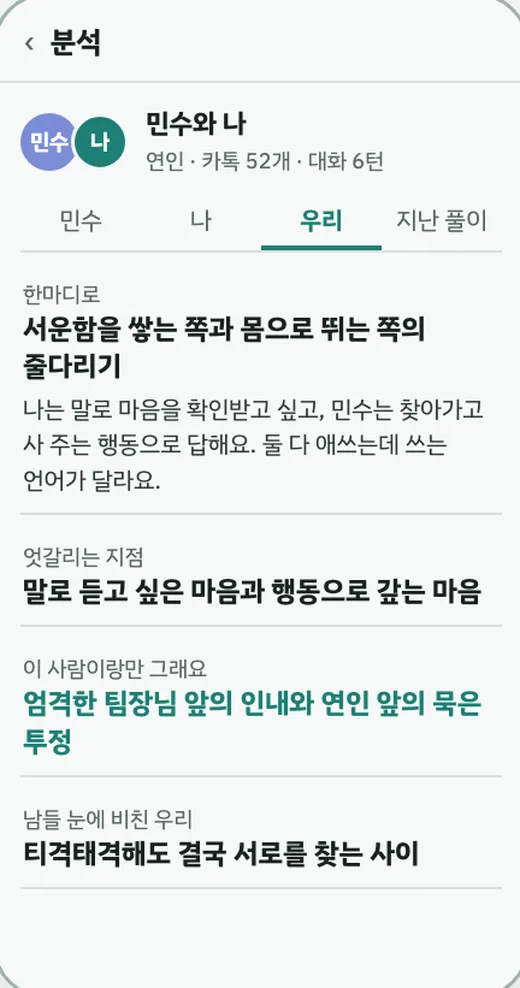
Prototype: analysis of the person, you, and the relationship
UnderstandPrototype screens, Oct 2026

What we don't do

Psychology is useful outside the clinic only if it stays honest about its limits. These lines hold for every product.

  • We don't diagnose.Scores are for reflection, and every result says so. When a pattern is worth a closer look, the reading tells you when.
  • We don't decide for people.We won't say who is right in a relationship or whether to end one.
  • We don't claim to read minds.A Meaning World character shows a possible reaction, not what the real person thinks.
  • We only use scales we can trace.Each one has a checked source and terms of use, and official Korean versions come first.

How we build

A small team shipping two live apps needs leverage. Ours is Claude Code.

Most of our development runs through Claude Code. We write specs with it, implement and review code with it, and use it for database migrations, tests and deployments on both live apps. Our psychology team checks every scale, translation and reading before it ships.

Next, we plan to use the Claude API to write personal readings of test results.

Built with Java and Spring Boot, React and Next.js, Postgres on Supabase, running on Azure and Cloudflare.

Who we are

We work in five teams.

Changyoul Park 박창율
Founder & CEO

Researches social psychology. Changyoul spent four years as a backend engineer and now leads product development.

  • Psychology researchChooses scales, checks licenses and translations, and writes the theory behind each reading.
  • Product developmentBuilds Meaning Test, the analysis engine and Meaning World.
  • Content & marketingMakes psychology videos and Instagram posts that bring people in.
  • User experienceRuns interviews and user tests, and reads the feedback.
  • StartupFinds support programs, partners and outside resources.

Questions, feedback or a project in mind? Write to us.

hello@meaningtest.com
Based in
Cheongju, South Korea
Started
April 2026